NIKKEI VIEW: The Asian American Blog

Bits of pop culture, media and politics from a Japanese American’s perspective by Gil Asakawa

NIKKEI VIEW: The Asian American Blog header image 1

Lunching at the Bagel Restaurant & Deli, Skokie Il

July 22nd, 2008 · No Comments

The Bagel is a boisterous, old-fashioned kosher deli in the Old Orchard Mall in Skokie, where Erin and I eat every time we visit Chicago. I always order an egg cream, a soda fountain fave from New York that I’ve never been able to order in Denver. Erin’s favorite is the Mish Mash, a gigantic bowl of chicken noodle soup with a huge matzoh ball floating in it, eclipsing a kreplach dumpling, rice and kashi. They also serve a delicious — if a tad on the dry side — homemade corned beef hash.

→ No CommentsTags: food · places

The legacy of Rocky Aoki and his Benihana restaurants

July 19th, 2008 · No Comments

Erin, Jared and I ate at a Benihana restaurant recently, and then learned just a couple of days later that Rocky Aoki, the founder of the Benihana chain, had died.

I wrote about my experience growing up eating at Benihana for special family occasions, and how in recent years, the restaurant only has one connection to being a Japanese eatery: its food. The staff at the one we go to, for instance, used to have one Japanese woman chef, which was a rarity in the entire company, but she’s been gone a couple of years now. The waitstaff and cooks are all non-Japanese, and as far as I can tell, the chefs are all Latino. They love to tell jokes about how they serve “Teri-juana” sauce (get it? Tijuana, teriyaki?).

They no longer are sent to Japan to train with master chefs like they used to decades ago. But they are all trained well as entertainers, and come up with some amazing tricks with their knives, throwing food around and catching the morsels. The food’s still good, which is why we go from time to time… probably once a year, if that. (YouTube has a lot of videos of dinners at Benihana, including the one above, of a birthday celebration. Most evenings at the restaurants are interrupted by the clatter of multiple birthday celebrations.)

The diners likewise are no longer Japanase or JA families. The diners are almost all white; a couple of weeks ago, we were the only Asians in the room.
[Read more →]

→ No CommentsTags: asian american · baby boomers · food · japan

Dining at Denver’s Korea House BBQ restaurant

July 19th, 2008 · No Comments

Erin, our friend Joe Nguyen and I dined the other night at Korea House, a popular restaurant in Denver (actually, Aurora, the eastern suburb, where the Korean community is concentrated). The dinner was part of an arrangement by Korea House to advertise in Asian Avenue Magazine, and we were there to write a preview of the eatery.

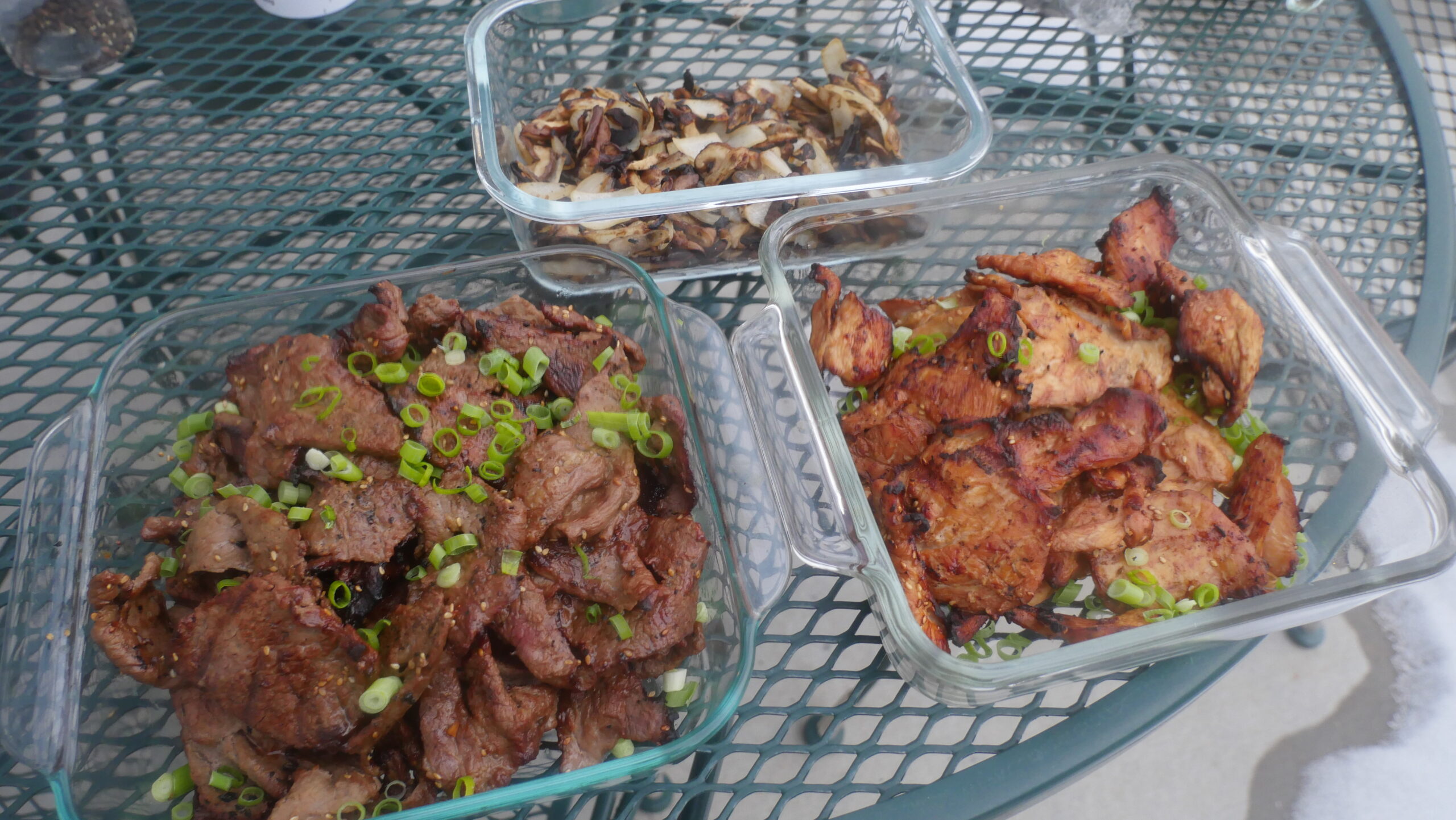
We had the full spread of Korean barbecue — Bulgogi (marinated sliced beef), Calbi (marinated beef shirt rubs, cut off the bone) and Spicy Chicken — as well as some Soon Doobu (seafood tofu stew) and Bibimbab (meat and vegetables served with spicy sauce over rice). The food was good (I’ll post a link to the advertorial when it’s up) and the experience was fun.
[Read more →]

→ No CommentsTags: asian american · food

Flipping for the Flip video camera

July 18th, 2008 · 1 Comment


I know some of my friends think of me as a gadget freak, but I only get crazed about a new toy every once in a while. iPods, for instance. Or digital cameras before that. Walkmans (Walkmen?) in the ’80s.

Here’s my newest gadget recommendation: We recently bought two Flip video cameras and we’re having a blast with them. I had checked out the Flip last year when they were first introduced — Costco sold them for a few weeks and then stopped carrying them.
Several months ago, our pal Bill Imada, founder of the IW Group media and advertising firm, held up a Flip after giving a presentation to the Colorado chapter of the National Association of Asian American Professionals, and told us we have to get one.

At Denver’s Cherry Blossom Festival in June, my brother Glenn Asakawa, a former photographer at The Denver Post now working for the University of Colorado, held up his Flip, and I was reminded that I wanted to get one.
[Read more →]

→ 1 CommentTags: baby boomers · media · pop culture · technology

Japanese Americans get the spotlight in Japanese American National Museum conference in Denver

July 17th, 2008 · No Comments

It’s been a couple of weeks since the Japanese American National Museum’s national conference was held in Denver. Sorting through the many bits of video I took over the conference, which ran July 3-6, my favorite parts were the tribute to JA veterans on the Fourth of July, and the July 6 bus tour to Amache, the internment camp in southeast Colorado.

The conference brought a bevy of famous and not-so famous speakers and panelists (I moderated a panel on Hapas, mixed-race Americans who are the future of the JA community) to Denver’s nice new Hyatt right by the nice new Convention Center. The famous included the likes of actor George Takei, a superstar in the JA pantheon; Sen. Daniel Inouye (D-Hawai’i), a Medal of Honor World War II veteran of the all-JA 100th Battalion/442nd Regimental Combat Team; Rep. Mike Honda (D-Calif.), who as a baby was interned at Amache with his family; former Congressman and U.S. Secretary of Transportation Norm Mineta; JA leaders and activists such as John Tateishi and Dale Minami; authors including mystery novelist Naomi Hirahara; Cynthia Kadohata, who writes books for pre-teens; and Uma Krishnaswami, who writes multicultural children’s books from a South Asian perspective.

The conference, which had the awkward and ungainly title but righteous theme of “Whose America? Who’s American?,” also brought more than 800 attendees and volunteers for the four-day span, meeting and greeting and learning about the history, present and future of not only Japanese Americans but also of Americans in general. One of the noteworthy speakers was Anan Ameri, the director of the Arab American National Museum, who spoke at a Plenary Session alongside JA scholars about internment, civil rights and the question of American identity posed in the conference title.
[Read more →]

→ No CommentsTags: asian american

Hooked on HGTV?

July 9th, 2008 · No Comments

One of the dangerous things about finally having cable TV, is tuning in to HGTV. For one thing, the network gives Erin way too many ideas for projects for us to tackle around the house. For another, it reveals my lack of ability to do most of the do-it-yourself projects that show up on the network’s programs.

What we noticed tonight, after several hours, was how diverse the network is with its shows’ hosts — especially the number of Asian Americans.

First we watched Hong Kong-born Vern Yip in “Deserving Design,” sort of a scaled-down version of the ABC hit show “Extreme Makeover Home Edition,” in which Yip, a doctor-to-be turned architect and designer, does makeovers of parts of a home for someone who deserves it. In this show, he helped a woman with cancer redo her kitchen and bedroom.
[Read more →]

→ No CommentsTags: asian american · media

School district officials object to valedictorians speaking Vietnamese

July 9th, 2008 · No Comments

I know I still need to blog the JANM conference, but I had to write about this: Officials at a Louisiana school district are trying to prevent students from including foreign languages in their graduation speeches.

The brouhaha was sparked by Vietnamese American cousins Hue and Cindy Vo, who were co-valedictorians at Ellender High School’s graduation in Houma, Louisiana. Cindy Vo spoke one sentence in Vietnamese dedicated to her parents, who don’t speak fluent English, from the podium.

Co len minh khong bang ai, co suon khong ai bang minh,” she said, and explained to her English-speaking classmates that the sentence roughly translates as “always be your own person.”

Her cousin Hue gave more of her speech in Vietnamese, but again, the point was to pay homage to her parents.

At least one member of Terrebonne Parish school district, Rickie Pitre, took offense to the Vietnamese passages, and he says that all graduation speeches should be given in solely English, or that passages can be paraphrased in foreign languages — but only after they’re spoken first in English.
[Read more →]

→ No CommentsTags: asian american · music

JANM conference: Reception at the Consul General’s home and media coverage

July 4th, 2008 · No Comments

It’s been a busy start to the conference organized by the Japanese American National Museum. We worked from home, setting up media coverage including sending a reporter and photographer from The Denver Post on a bus trip to Amache, the WWII internment camp in southeast Colorado. The result this morning is a powerful, well-written A-1 — front page — story by Jordan Dresser, with photos by Helen Richardson (kudos to the DenverPost.com staff, who added a couple of the extra photos from the print edition onto the online story).

Last night Erin and I attended our first official conference event, because Erin wasn’t feeling 100% during the day. We went to a reception for the conference at the home of Kazuaki Kubo, and mingled with Denver’s Japanese American leadership, and the likes of former JANM Executive Director Irene Hirano (who recently married Sen. Daniel Inouye of Hawai’i, who wasn’t at the reception but will be at the conference today for the veteran’s salute), former Transportation Secretary Norm Mineta and actor/JANM President George Takei.
[Read more →]

→ No CommentsTags: asian american · japan · pop culture

Digging up the past at the Amache internment camp

July 3rd, 2008 · 1 Comment

The JANM conference that starts today in Denver has a whole bunch of interesting and important panels, workshops and discussions. I’m moderating one on Saturday, about Hapas — mixed-race Asian Americans. But some of the most powerful parts of the conference will be the ones that bring people together with their past.

Today and Sunday, caravans of buses will be taking conference attendees to southeast Colorado, to the Amache concentration camp near the town of Granada (the official name of the camp was Granada Relocation Center) where more than 7,000 Japanese Americans were imprisoned during World War II.

Erin and I will be hosting one of the buses on Sunday. The day will begin at 6am and we’ll return in the evening — the drive to the camp takes about 3 1/2 hours through desolate eastern plains terrain.

I’ll blog about the trip afterwards, but I wanted to share a couple of links about Amache:
[Read more →]

→ 1 CommentTags: asian american · places

Japanese energy drink is a “beer” for children

July 1st, 2008 · 1 Comment

Considering that many — if not most — Asians are allergic to alcohol, it’s amazing how much the culture of alcohol is part of society in Japan. I guess it’s the same all over the world, but since I’m very allergic to alcohol, I’m just out of the loop when it comes to booze.

You’re probably familiar with the nightly practice of businessmen going out with their fellow “salarymen” after work and dining and drinking themselves into a stupor before trudging home to the families they hardly see. I can sip half a glass of beer and I turn bright red and splotchy, my eyes glow in the dark and I get dizzy as hell. It was hard to go out drinking in high school when my face gave myself away whenever I stumbled home and mom was up waiting for me. I guess if I were with co-workers who were all equally red, I wouldn’t have been so self-conscious.

Anyway, I recently came across what looked like a cool soft drink at Pacific Mercantile, the Japanese grocery store in downtown Denver, and I realized that Japan’s alcohol culture starts earlier than I thought, and in insidious ways.

I saw a display for bottles of a drink called “Kodomo no Nomimono,” with a cute retro 1930s illustration of a child on the label, and the words, which translate as “Children’s Drink” written out in hiragana, the simplified alphabet that’s familiar to Japanese school kids.

The bottles were on sale — buy one, get one free — so I bought one to try, and got one for my friend Jordan, the “Energy Examiner” for Examiner.com. He wrote about Kodomo no Nomimono, and found to his shock that the stuff is marketed as a beer for kids by its manufacturer, Sangaria, the makers of the popular lemonade-flavored pop, Ramune. [Read more →]

→ 1 CommentTags: asian american · food · japan

Honoring Japanese American veterans for the 4th of July

June 29th, 2008 · 1 Comment

The Japanese American National Museum is sponsoring a conference in Denver over the Fourth of July weekend, called “Whose America? Who’s American? Diversity, Civil Liberties, and Social Justice.”

Erin and I are helping out the conference, and one of Erin’s main projects has been contacting and inviting Colorado Japanese American veterans to the conference’s Welcome Ceremony on July 4, during which the vets will be honored for their service. Many of them are elderly veterans of the 100th Battalion/442nd Regimental Combat Team, who fought in Europe during WWII even though many of them had family members living behind barbed wire in U.S. concentration camps.

These men, as well as their lesser-known Pacific campaign counterparts, the Military Intelligence Service (MIS) who fought in the Pacific, for the country that imprisoned them at the start of the war just to prove their patriotism, remain today the most highly-decorated combat unit for its size and length of service in U.S. military history. In one celebrated battle, the men of the 442nd, whose motto was “Go for Broke!,” suffered over 800 casualties to save 211 men of a Texas “Lost Battalion” in the Vosges mountains of France towards the end of the war.

It should be a moving tribute to these men, and the veterans will include both Hawai’i Sen. Daniel Inouye, who lost an arm as a member of the 442nd, and former Transportation Secretary Norm Mineta, who served in the Army during the 1950s.

They’ll join over two dozen Colorado veterans as well as JA veterans from all over the country who are attending the conference. [Read more →]

→ 1 CommentTags: asian american

Are newspapers finally embracing the Web?

June 23rd, 2008 · No Comments

Leave it to a former rockcrit — and a McClatchy employee (the company just cut 10% of its workforce nationally) — to come up with an eloquent essay on the decline of the newspaper industry and the ascension of the Internet.

Online people, myself included, have been saying for years that the Web should be first in news priority, and that journalists shouldn’t think that they work for newsPAPER companies, but instead NEWS companies. Maybe, coming from an august writer like Leonard Pitts, a world-class columnist at the Miami Herald, this idea will start to sink in with those of you who still have ink in your veins.

He sounds like speeches and conversations I heard going on a decade ago, but better late than never, I say:

We still tend to regard our websites as ancillary to our primary mission of producing newspapers. But I submit that our primary mission is to report and comment upon the news and that it is the newspaper itself that has become ancillary.

So maybe we should regard the Internet not as an extra thing we do, but as the core thing we do.

[Read more →]

→ No CommentsTags: baby boomers · media

Hollywood’s continuing fascination with yellowface

June 21st, 2008 · 3 Comments

Growing up, I didn’t think much about it, but seeing old Westerns now, it’s amazing to me that movies got away with casting white people in the roles of American Indians or Mexicans — almost always as “bad guys.”

Seeing these movies today, you could tell they’re not ethnic actors, and could almost see the smudges from the makeup smeared over their faces and hands. It wasn’t any more sophisticated than the blackface makeup white actors wore to play African American roles in silent movies or the early talkies, wide-eyed, shiny black visages like masks, singing about “mammy.” You don’t see that any more, at least, not with blacks and Latinos.

Hollywood also has a long and tiresome tradition of “yellowface” — having Caucasian actors portray ethnic Asian roles. And, unfortunately, you can still see that on the big screen today.

The most famous early examples of yellowface are the various actors from Warner Oland and Boris Karloff to Peter Sellers who played the evil, inscrutable Fu Manchu; Oland and Sidney Toler as the detective Charlie Chan in a series of hit movies; and the German-born, diminutive Peter Lorre as the Japanese detective Mr. Moto in another string of movies.

Even the great Katharine Hepburn, one of my favorite actresses, put on yellowface, to play a Chinese woman in the 1944 movie “Dragon Seed.” [Read more →]

→ 3 CommentsTags: asian american · pop culture

More on the ‘model minority’ myth and CU’s racist column

June 21st, 2008 · No Comments

The Boulder Daily Camera today ran a front-page story about the recent study about Asian Americans and the model minority myth.

The study found that because Asians are not all high-achieving academic wiz-kids, and that the diversity of the Asian communities (we’re not just Japanese, Chinese and Koreans, but also Laotian, Hmong, Cambodian, Indian, Filipino, Vietnamese, and so on) and the range of generations from first-generation immigrants with poor English skills to fourth, fifth or sixth generations of Americans, leads to a reality that’s less modeled and more uneven. Not all Asian Americans go into the top Ivy-League schools, either: a growing number is opting to go to community colleges instead of major universities.

The article quotes CU professor Daryl Maeda, an assistant professor of ethnic studies:

Another part of the “model minority myth” — that Asian-American students should perform well in science, technology, engineering and math fields — also can be unfair to students, Maeda said.

“Some are great at music or English,” Maeda said. “And if they don’t live up to the model minority myth it puts an extra pressure on them, giving them the idea that they somehow aren’t good enough in their endeavors.”

[Read more →]

→ No CommentsTags: asian american

A “non-beauty” pageant for Asian American women in Colorado

June 18th, 2008 · 1 Comment

It’s been a couple of weeks, but congratulations are in order for Amanda Igaki, the winner of the “Miss Asian American Colorado” pageant held in Denver May 31.

Now, before you recoil at the thought of a beauty pageant, rest assured that this pageant, organized by a crew of young people led by the energetic and entrepreneurial Annie Guo, whose family publishes Asian Avenue Magazine, was not a traditional beauty pageant. The most obvious proof that this wasn’t a typical pageant was the lack of a swimsuit competition.

In fact, although Igaki was crowned “Miss Asian American Colorado” at the end of the four-hour event (which felt much shorter because it was so interesting), it didn’t feel like a competition between the 26 contestants at all. These women had become close friends, like a small, tight sorority.
[Read more →]

→ 1 CommentTags: asian american · places

Tiger Woods: The most influential Asian American?

June 17th, 2008 · 1 Comment

Update 18 June: News media are reporting Tiger Woods will miss the rest of this year’s golf season because he needs more surgery on his left knee. That’s a big bummer, but not surprising, given how he grimaced after many of his tee-offs. I almost winced with empathy pain as he twisted his knee each time.

Everyone’s favorite hapa/Asian American, Tiger Woods, is important enough news to accomplish a pretty impressive feat.

I’m not just talkin’ clinching the U.S. Open Championship in a nail-biting last round and sudden death match against Rocco Mediate. I’m talkin’ about pushing up the publication date of one of the most popular magazines in the country, Sports Illustrated.

MinOnline.com reports that the July 23 issue of the mag, which had been scheduled to hit the newsstands with a Woods cover on Wednesday, was rushed to the printers early, and is already out, one day after the golf superstar’s victory. [Read more →]

→ 1 CommentTags: asian american · places

Another voice on the ‘uppity’ issue and other coded language

June 15th, 2008 · 2 Comments

Here’s a blog post I just came cross, from AdAge.com, that adds to the dialogue on the use of the word “uppity” to describe African Americans.

Pepper Miller points out that some African Americans take the use of “elitist” to describe Barack Obama as code for “uppity”:

As another example, WVON-AM Chicago talk-show host Perri Small nailed the rationale for black frustration over charges of Sen. Obama’s “elitist” attitude during an appearance on CNN last month. Ms. Small explained that many in the black community took “elitist” to mean “uppity,” a particularly troublesome translation as the term “uppity” dates back to pre-Civil Rights and the Jim Crow era. Despite progress in the black community, “uppity” continues to be perceived as code for blacks who do not “stay their place.”

[Read more →]

→ 2 CommentsTags: asian american

The myth of Asian Americans as the “model minority”

June 10th, 2008 · 2 Comments

Stereotypes sometimes are based on a kernel of truth, but they’re twisted and blown out of proportion and used out of context. Sometimes, stereotypes can even be “good” in that they’re not negative images. But trust me, a stereotype is still a stereotype. It’s a generalization that’s not universally true, and even the good ones are impossible to live up to.

Asian Americans are very familiar with the stereotype of the “model minority.” It goes like this: Asian Americans are smart, quiet, dependable, hard-working and never complain. Asian American kids are smart, quiet, straight-A students, play classical music on instruments like piano, cello and violin, and never complain.

It’s all hogwash, of course… but it’s based on that kernel of truth.

Asian Americans were known for a hundred years for successfully assimilating into mainstream American society. It never completely worked because we could never be accepted racially into the mainstream like European Americans could, but Asian immigrants and their families worked hard to become economically successful in America.

But a brand-new report published by New York University, the College Board and Asian American educators and community leaders found that the idea of “model minority” is a myth, and that the APA (Asian Pacific American) population is as diverse and no more homogeneous than the rest of America.

“Certainly there’s a lot of Asians doing well, at the top of the curve, and that’s a point of pride, but there are just as many struggling at the bottom of the curve, and we wanted to draw attention to that,” said Robert T. Teranishi, the N.Y.U. education professor who wrote the report, “Facts, Not Fiction: Setting the Record Straight.”

[Read more →]

→ 2 CommentsTags: asian american

How do you feel about an MSNBC reporter calling Spike Lee ‘uppity’?

June 9th, 2008 · 4 Comments

Clint and Spike are having a spat. (from Gawker.com)

File this under “you’re too sensitive” if you want, but I think people of color notice these types of media mistakes because they reflect, deep-down, America’s lack of evolution on the diversity front.

From Gawker a few days ago: an MSNBC reporter described Spike Lee as “uppity” because of his back-and-forth spat with Clint Eastwood over the lack of African American soldiers represented on his two films about the World War II battle for Iwo Jima, “Flags of Our Fathers” and “Letters from Iwo Jima.” When Lee’s criticism, which he made when he was at the Cannes Film Festival in May, was published, Eastwood responded that Lee should “shut his face.”

I linked to the Gawker story in my Facebook page, and this morning I got an IM from a friend in New York, Peter V, who said he didn’t get what the fuss was about. “Forgive my ignorance - but is ‘uppity’ a racial slur? I missed that one,” he said.

I thought about it, because I had immediately linked to the Gawker piece, but upon reflection, he was right “uppity” in itself is not an offensive word. It’s the historical context that I was responding to.

“In itself, no,” I replied. “But someone in the national media should know the loaded nature of using the word when referring to a black man…. She may not have meant anything by it, but shame on her. It has hundreds of years of hate and hangings behind it…”

As I explained in a follow-up email, the parallel, for me, is that I grew up hearing the phrase “sneaky Japs” — all my life, from other kids in school, on the playground, at work (back in the day, when workplaces were less enlightened) and elsewhere, from all ages. [Read more →]

→ 4 CommentsTags: asian american

Why Harold and Kumar are important, as embarassing as they are

June 8th, 2008 · 2 Comments

The characters Harold and Kumar, played by APA actors John Cho and Kal Penn, are like embarassing uncles who fart in public and cuss and tell stupid jokes. In fact, in lots of ways, Harold and Kumar are stupid jokes.

But like those uncles, you have to embrace them when you see them, even though you wince every time they walk in the room.

That’s because in their 2004 debut, Cho and Penn’s characters smashed Asian American stereotypes about being the model minority. Cho played Harold, an earnest numbers-cruncher by day who has the hots for a hot neighbor and has the internalized heart of a slacker; Penn’s Kumar is the slacker externalized. He’s a pot-hound and horndog and crude as he can be, always trying to drag Harold into his slackdom. Kumar is supposed to become a doctor, and it turns out he’s quite capable, except he’s pathologically incapable of following his ethnically preordained career path.

The two go on a marijuana binge and seek out a White Castle burger, or more accurately, a whole bunch of ‘em, to assuage their munchies. (It helps to understand the plot if you’ve enjoyed the strange pleasures of a tiny White Castle “slider.”) [Read more →]

→ 2 CommentsTags: asian american · pop culture